May 4, 2026
The Story of EVnSteven
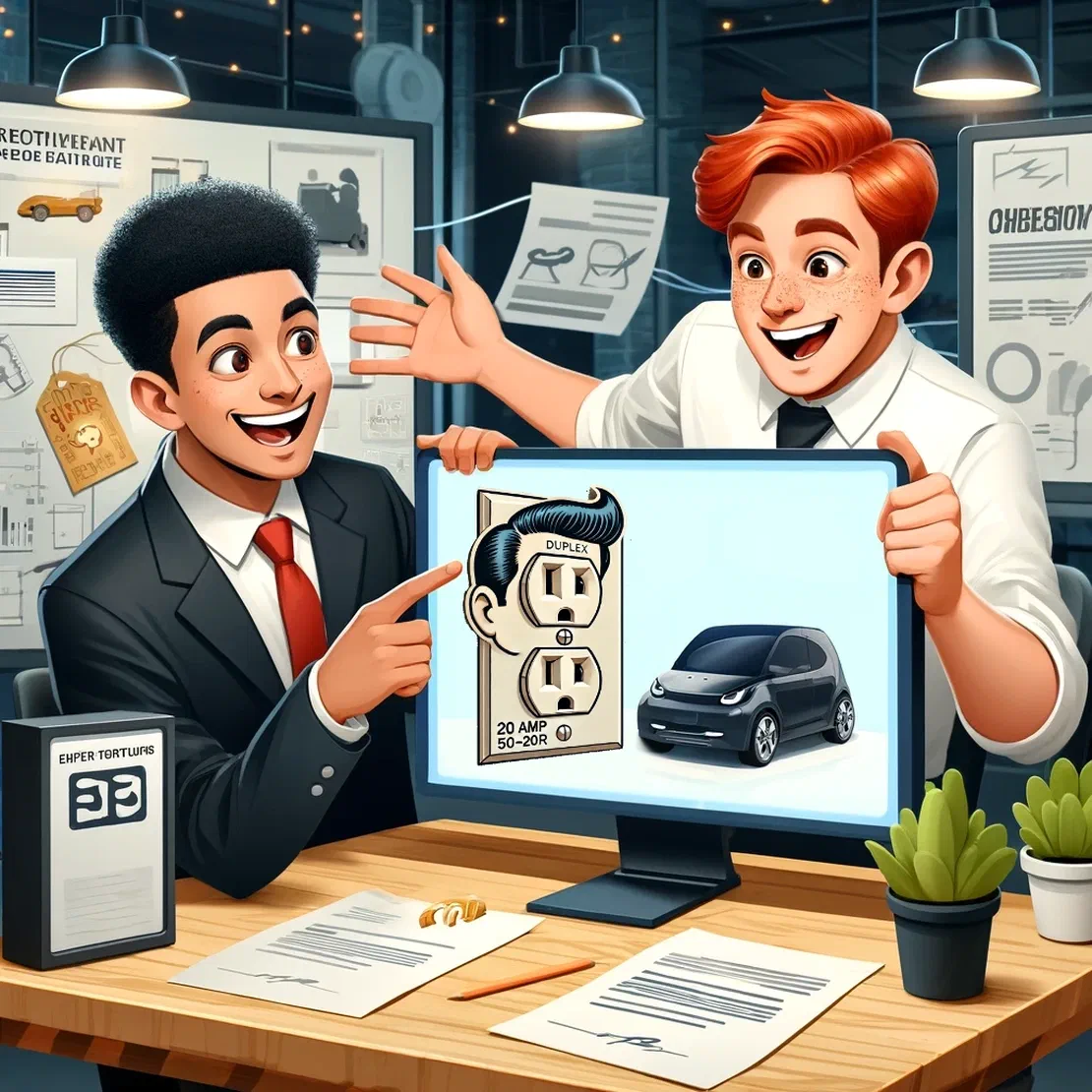
A burning car. A dying mother. A strata council that accidentally banned its own charging station. And a chance encounter with someone who became a business partner and a close friend.
My name is David Williston. I’m the co-founder of EVnSteven. This is how it started.
Before she died, my mother gave me three instructions: take her money, buy a new car, and get rid of the murdercycle. She suggested the Kia Soul — she really liked it. I wasn’t excited about it. She asked me to test drive it anyway.
The test drive sold me. A year after she passed, I bought a red one in her memory.
Four years later, that model was identified as a fire hazard. I kept an extinguisher in the back seat. I’ll never sell my Soul, I said jokingly. And I meant it.
When the warranty was almost up, I took it in for a final checkup. While I sat in the waiting room I saw something on the showroom floor: same body, same roofline, same car — but silver, with a small badge that said EV. I didn’t know Kia made one. I asked to drive it.
Effortless acceleration. No engine noise. And it was her car.
I told the salesman I couldn’t sell my Soul.
He laughed, then ran the numbers. Federal incentives. Provincial incentives. A strong trade-in on a car known for catching fire. Net cost: $22,000 for a brand new 2019 Kia Soul EV with a sunroof and a clean conscience.
I bought it on the spot. Technically I traded my Soul. So there.
A few months earlier I’d rented a unit in a brand new 42-unit building. Small enough to feel like a real community, I thought.
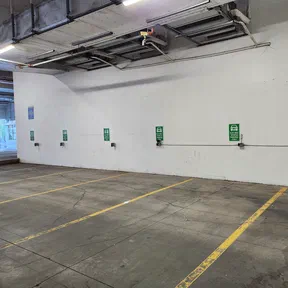
There was an EV charging station in the parkade. Brand new. Completely unused. It sat there like a small prophecy.
A few months later I had an EV. I had a place to charge it.
For nearly two years, everything worked.
Then other people started getting EVs.
By 2022 we had four or five EVs sharing one station, coordinating by text message. Done by 10. It’s yours after that. It worked, barely, through patience and goodwill.
I could feel the strata watching. Suspicious. Disapproving. The charging station had been the developer’s idea — an amenity written into the original bylaws. The strata hadn’t asked for it and didn’t want it. They were retirees, most of them, and they’d read enough petroleum industry propaganda to believe that EV charging was draining the entire building’s power supply and costing everyone a fortune. It wasn’t. But try telling them that.
So I started collecting data before the dispute arrived. Built a Google Sheet. Asked my neighbours to log their sessions: date, battery size, starting charge, ending charge. The math was simple. Electricity cost $0.125 per kilowatt-hour. Battery times percentage equals kilowatt-hours. Kilowatt-hours times cost equals the bill.
October total: $52.09 across three neighbours — calculated to the cent. Spread across 42 units, that’s $1.24 per unit. The fortune they were worried about.
That spreadsheet was the seed. I didn’t know it yet, but I was already building the product. The spreadsheet used battery delta — start percentage, end percentage, do the math. It worked, but it put the burden on the residents to log their own data honestly and accurately. Nobody wants to do that forever.
Later I realized there was a better way. Power draw is constant for a specific vehicle plugged into a specific outlet. Always. Which means you don’t need battery readings at all — you just need time. Check in, check out, done. The billing calculates itself.
Around the same time I’d been playing with Flutter, a new mobile app framework. And I kept thinking the same thought: someone should build an app for this. Check in, check out, get your bill. No special hardware. No metered station. Just physics and a little trust between neighbours.
I thought about it for a year. Then I met Mekonnen.
He showed up in a Flutter subreddit where I was answering questions. His questions were precise. His thinking was clear. His code was organized in a way that told me: this person thinks carefully.
He was 24. Just graduated from university in Bahir Dar, Ethiopia — nearly 17,000 kilometres from Vancouver Island. He’d taught himself English so he could teach it in the summers and earn enough money to buy his own laptop. His sister matched what he saved. Now he had the tools to build a career as a software engineer — if someone would give him a chance. Companies kept passing on him. They’d see his address and move on.
Their loss.
I was a little bored. I had some extra time. A little extra money — not much. And he was very affordable. I decided to hire him for one week. Just to give him a break. A chance.
I wasn’t looking for an employee. I was looking for something interesting to do — and I found something much better than that.
Mekonnen showed up to our first call exactly on time. Visibly nervous. I told him to relax — nothing serious was at stake, just two people making something.
One week became two. Two became three. Three years later, he’s my business partner. He never once tried to take advantage of the situation. Showed up every day, on time, professional, and genuinely grateful in a way that made me reflect on how much I take for granted.
We built three experimental apps over three months. None of them became businesses. But I knew what he was capable of. And I had a fourth idea.
An EV charging tracker. Let’s start building.
That was when EVnSteven began.
Six to nine months later we had something production-ready.
While we were building, something absurd was happening at my building. Five EVs, one station, everyone texting to coordinate. Then I noticed something I’d walked past a hundred times: a standard wall outlet on the column next to my parking stall. On a whim, I plugged in. In the morning, the car was fully charged.
I stopped using the dedicated station entirely.
The strata took notice. I was asked to justify myself. I pointed to the bylaws. Nothing prohibited it. They looked. I was right.
So they rewrote the bylaw.
What followed was one of the more spectacular own-goals in residential governance history. The new bylaw stated that Level 2 charging was not permitted and Level 1 wall outlets were the approved method going forward.
They had mixed up the terms. Level 1 is a wall outlet. Level 2 is the dedicated station.
They had accidentally banned their own charger.
Changing a bylaw requires a Special General Meeting. They weren’t willing to call one. They were stuck with it for a full year.
The dedicated station sat unused for twelve months — locked out by the building’s own legislation — while I charged happily from my outlet. Everyone else quietly started using the government charger next door. The one that’s supposed to be for government employees only.
Around the same time, a strata elsewhere in BC imposed a flat monthly fee for EV charging. A resident challenged it. The tribunal ruled: without actual measurement of electricity consumed, a flat fee is unenforceable. Buildings need metered hardware — which costs thousands of dollars — or software that tracks actual usage.
EVnSteven is the software.
We launched in 2023. People are slowly finding us, but it’s a challenge. EVs are still relatively rare, and we need a very specific type of person — someone who has one, lives in a multi-unit building, and cares enough to do something about the charging situation. That’s a small slice of the population. For now. The market is growing every year and we’re growing with it. Getting in front of the right people, at the right moment — that’s the work we’re doing now.
I eventually left the building. The conflict had worn me down. Some councils are run by people who would rather create friction and conflict than harmony and community. The people who need EVnSteven most aren’t always the people closest to you. Sometimes you have to go farther to find the ones who are ready.
Mekonnen is now my business partner and one of my closest friends. We are still building and refining. The problem hasn’t gone away — it’s getting bigger every year.
EVnSteven exists because of a dangerous car, a deathbed gift, a strata council that missed the point, a Google spreadsheet, and a chance encounter with someone who became a business partner and one of my closest friends.
EVnSteven is a software-only EV charging billing platform for multi-unit residential buildings. No special hardware required. Works with any existing outlet or Level 2 station. Available on iOS and Android.