October 26, 2026
The Infrastructure of Distrust

When I started building EVnSteven, I approached the problem from first principles: how do we reduce the cost of EV charging to something approaching the actual cost of electricity?
To me, it’s absurd to pay $0.32 per kWh for electricity that costs $0.08. That’s a 300% markup.
The physics are remarkably simple. Level 1 and Level 2 charging operate at approximately constant power under normal conditions, so energy consumption can be estimated as a function of time:
Energy (kWh) = Power (kW) × Time (hours)
Charging power can vary, of course. Vehicles taper their charging rates, batteries reach full capacity, and environmental conditions affect performance. But for ordinary residential charging, time-based estimates can be sufficiently accurate for practical cost sharing.
So I questioned the entire architecture and started deleting things.
- ✕Dedicated metering hardwareDeleted
- ✕Proprietary communication protocolsDeleted
- ✕Payment intermediariesDeleted
- ✕Complex billing systemsDeleted
- ✕Expensive charging infrastructureDeleted
- ✕Network connectivity requirements for charging hardwareDeleted
- ✕Automated enforcement mechanismsDeleted
None of this means electrical safety, reliability, or accountability are optional. They’re essential. But safety doesn’t require a proprietary charging network, and accountability doesn’t necessarily require expensive measurement and enforcement infrastructure.
And yes, time-based billing introduces some inaccuracy. But insisting on expensive precision to account for a few cents of electricity can be the very definition of being penny-wise and pound-foolish.
The real engineering question isn’t how accurately we can measure electricity. It’s whether the economic value of that additional accuracy justifies the cost of achieving it.
The goal is economic efficiency, not laboratory-grade measurement.
The objective wasn’t to make the existing system slightly cheaper. It was to rethink what the system actually needed.
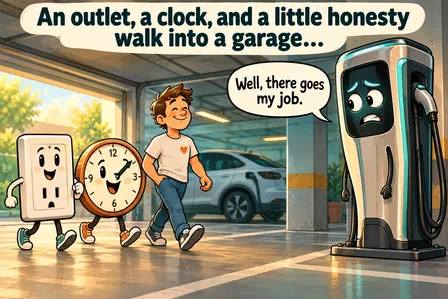
Obviously, this approach won’t work for public charging. When the people plugging in are strangers who will never see each other again, metering, payment and enforcement earn their keep.
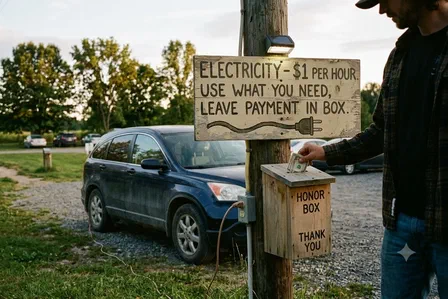
But private settings, such as apartment buildings, condos, workplaces and shared garages, are different. The people involved are neighbors and colleagues. I can’t find a good excuse for all that infrastructure there, other than a fundamental distrust of the members of a community.
And along the way, I discovered something fascinating: a significant amount of the complexity we’re paying for exists because we’ve designed systems around the assumption that people cannot be trusted.
I started by optimizing for cost. I ended up realizing that trust might be the most powerful optimization of all.
So remember that the next time you plug your car into a fancy, networked Level 2 charging station.
You’re not just paying for electricity. You may also be paying for an entire infrastructure of distrust.
David Williston
Founder, EVnSteven.app
Your building is ready for EV charging.
Charge EVs at the outlets you already have. Drivers pay for the time they use.
Get EVnStevenSubscribe to EVnSteven Notes
We use your email only to send these notes. Unsubscribe from any email. Privacy policy