October 31, 2026
It All Started With the Smell of Gasoline
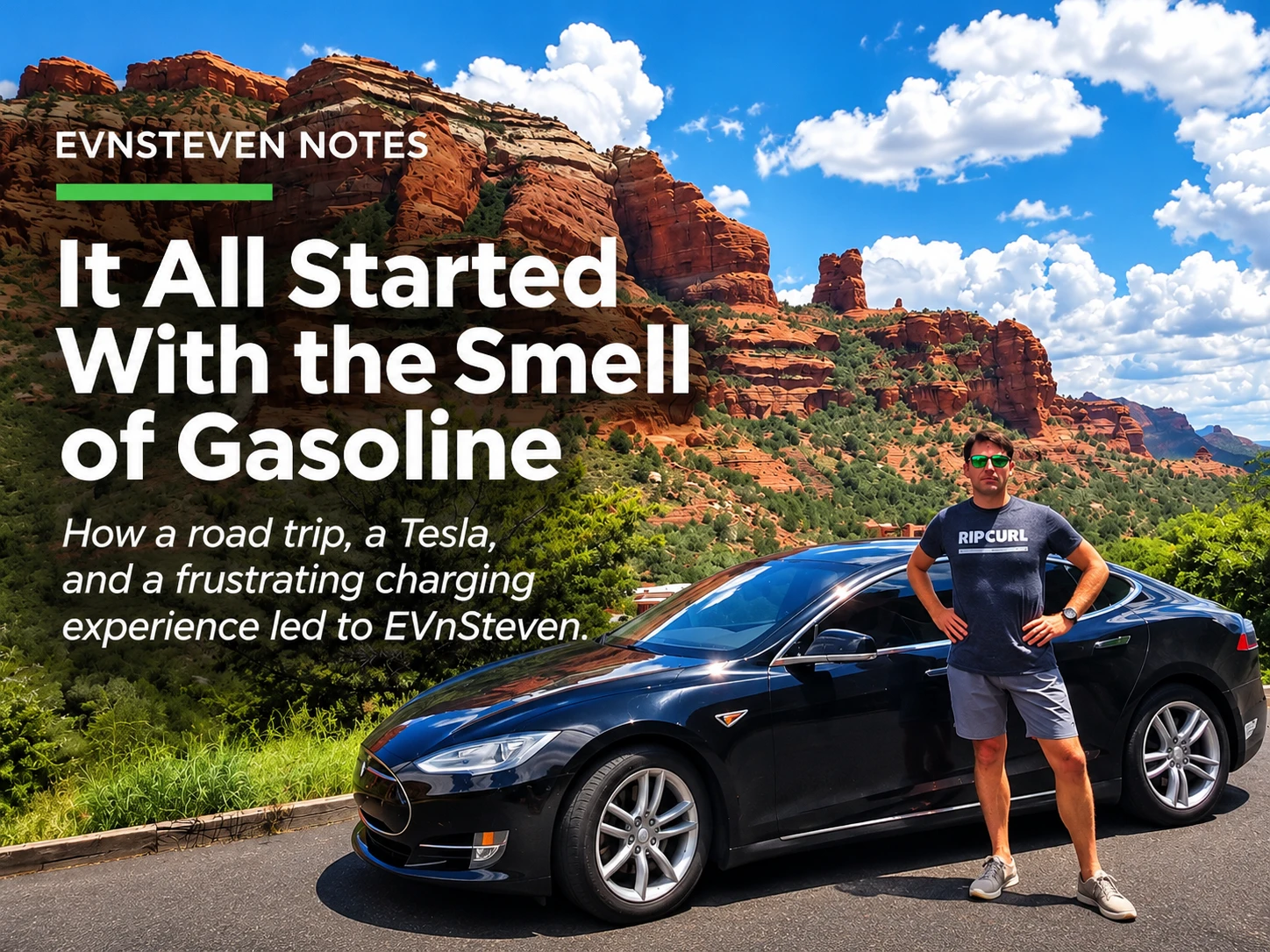
It was August 2017, and I was sitting in a rented Tesla at a Supercharger in Sedona, Arizona, when I smelled gasoline.
It was 95 degrees outside, and we’d been sitting there forever. I didn’t yet understand that charging a battery from 80% to 100% could take so long, especially in extreme heat. The Tesla was struggling to keep its batteries cool.
At the time, I owned a 2014 Kia Soul, and I’d been reading disturbing reports about Kias catching fire across the United States. For a split second, that familiar concern came rushing back.
Then I remembered I wasn’t in my Kia.
The smell was coming from the gas station next door, where a tanker truck was filling the underground tanks. I had to laugh at myself. Although, given the heat, I was also a little worried about the Tesla catching fire.
Neither did.
Despite the long wait, I loved the Tesla charging experience. You just plugged it in. No apps, no credit cards, no instructions. The car and charger took care of everything.
I admired that simplicity.
In 2019, I traded my gasoline-powered Kia Soul for a 2019 Soul EV. That’s when I discovered what charging was like outside the Tesla ecosystem.
I needed different apps for different charging networks. Some required prepaid balances. Others needed a cellular connection to communicate with a server before they’d even deliver electricity. Sometimes the whole process failed.
It was ridiculous.
What surprised me most was that much of this charging infrastructure had come along after Tesla had already demonstrated how simple the experience could be. Technology that comes later should be better, shouldn’t it?
Tesla had set the bar. Yet major automakers and charging companies, including businesses with enormous financial and engineering resources, had somehow managed to deliver a more complicated experience.
Instead of coordinating around a seamless charging experience, the industry had left consumers juggling apps, accounts, payment systems, and incompatible networks.
Companies like GM, Toyota, and Kia had vastly greater resources than Tesla did in its early years. Surely they could have worked together to make charging as simple as plugging in a car.
But apparently, that was too much to ask.
Then I noticed something interesting in the underground parking garage of my condo building. There was an ordinary electrical outlet right beside my parking stall.
I started plugging into it. I hadn’t asked permission, but there was no rule against it, and the building already provided a shared Level 2 charging station as an amenity. By charging at my own stall, I was leaving that station available for the other EV owners.
And that’s when I made a discovery that changed how I thought about electric vehicles.
Level 1 charging was amazingly effective.
Most days, my car sat parked for hours. I didn’t need to charge quickly. I just needed to replace the electricity I’d used driving around town. An ordinary outlet could easily handle most of my daily driving. You can find out whether that’s true for your own driving with our EV Home Charger Calculator.
Better still, the experience was exactly what I’d loved about Tesla.
Plug in. Walk away.
No app. No network. No complicated electronics negotiating with servers somewhere on the internet.
I began wondering why condo and apartment buildings were spending thousands of dollars on sophisticated charging equipment when ordinary outlets or inexpensive Level 2 stations could do much of the job.
The electricity was already there. The charging technology was already inside the car.
What was missing was a simple way to track who used how much electricity and what they owed.
Of course, that would require some trust. Drivers would need to check in and out honestly. But in a condo or apartment building, where residents already have an established relationship and a contract with the property, that seemed perfectly reasonable.
And if there was no internet connection in the garage? Who cares? Plug in, charge your car, and record or adjust the session later.
I couldn’t stop thinking about it.
Eventually, I decided to build the software myself.
I called it EVnSteven.
A simple way for people to share existing electrical infrastructure, track charging time, and pay their fair share without expensive hardware or unnecessary complexity.
Looking back, I find it amusing that the whole journey began with a gasoline smell in the Arizona desert.
But the real revelation came much later, in an underground parking garage, when I discovered how much technology we didn’t actually need.
David Williston
Founder, EVnSteven.app
Your building is ready for EV charging.
Charge EVs at the outlets you already have. Drivers pay for the time they use.
Get EVnStevenSubscribe to EVnSteven Notes
We use your email only to send these notes. Unsubscribe from any email. Privacy policy
What our founders are building next
Besides EVnSteven, our founders are working on these:
 Ride-hailing, launching very soon
Kimem (opens in a new tab)
A ride-hailing service for Bahir Dar, Ethiopia, from founder Mekonnen Alemu. Riders see a fare estimate before they book, watch the nearest driver approach on a map, and pay the metered fare in cash at the end of the trip.
 Non-profit, open source
StrayCats (opens in a new tab)
A project from David to help people who care for street cats, stray cats, or any cat, even if that cat happens to be a dog. It's still at the idea stage, with no app yet, and David would love your ideas and feedback. Dedicated to Saibo, 2010–2026.
 Cash tracking, free, launching soon
Effectivo (opens in a new tab)
Imperfect accounting with a twist, for those who use cash. Log a purchase in a few taps, count what's in your wallet, and look back at what was worth it. The twist is that everyone who keeps using cash helps keep it around for everyone else. Free and ad-free, coming to Android and iPhone, with a beta and a web demo running now.