October 23, 2026
What Charger Do You Actually Need? We Built a Calculator to Find Out
Ask ten people what charger you need for your new EV and you’ll get ten confident answers.
“Get a 48-amp Level 2 charger. Don’t skimp.”
“Just use the wall outlet. That’s all I’ve ever needed.”
“You’ll need an electrician and a panel upgrade.”
The opinions are loud, big and overconfident. But nobody knows your commute, your car, or your budget. They’re guessing.
We recently built a calculator to replace the guessing with arithmetic. It’s free, it runs in your browser, and you can try it here: EV Home Charger Calculator.
Note for international readers: this article is translated, but the calculator is English only for now.
A calculator disguised as a story
Most calculators greet you with a form. Fill in twelve boxes, press a button, receive a number.
We didn’t want that. The right charger depends on the shape of a whole week, and a form is a poor way to show a week. So the calculator is a story.
You meet a driver, David (yes, that’s me, but you can type your own name and the story becomes yours). David has just won the argument with the people who told him not to buy an EV. Now a new fight begins: which charger should he put in his home?
You follow his typical week. He drives to work and back on weekdays. He takes a short trip on Saturday and a longer one on Sunday. Every number in the story, such as the distance, the departure time and the battery size, is tappable. Change it to match your own life and the story rewrites itself around you.
What it actually does
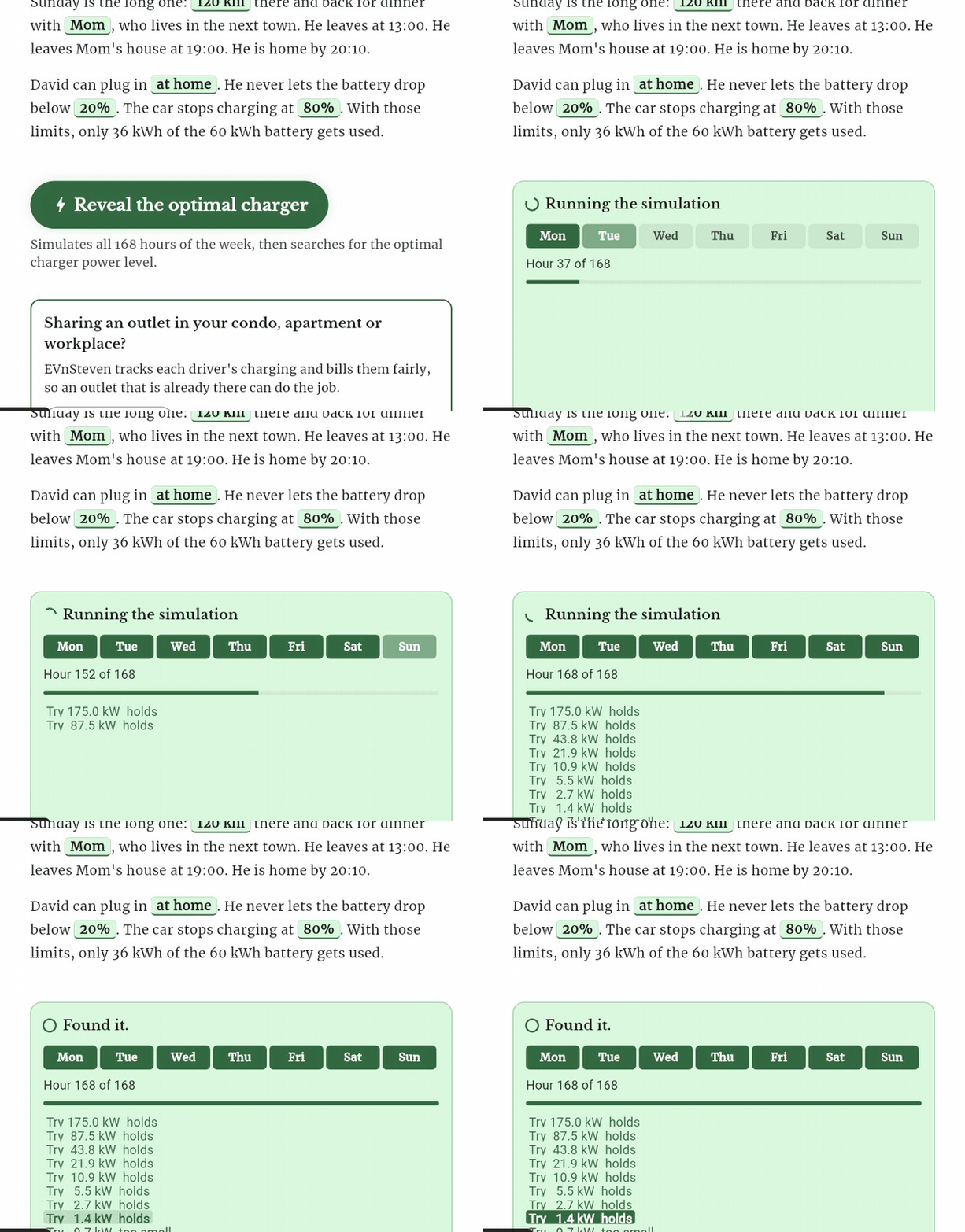
Behind the story is a simple simulation. It lays out your week hour by hour: when the car is driving, when it’s parked, and where it’s parked. Driving drains the battery. Plugging in refills it.
Then it asks one question: what is the smallest charger that never lets the battery drop below your comfort floor?
You set that floor. It’s 20% by default, and you can move it. You also set where charging stops (80% by default, kinder to a lithium battery than a daily 100%), and whether you can plug in at home, at work, both, or nowhere.
The answer isn’t a vague “Level 2.” It names the actual thing you’d ask an electrician for, shows a picture of the outlet, and gives the volts and amps. For example, 240 V at 40 A on a 50 A circuit. That 40-amp figure isn’t a typo. Charging counts as a continuous load, so a circuit is worked at 80% of its breaker rating.
The surprise
For many weeks, the answer is smaller than people expect.
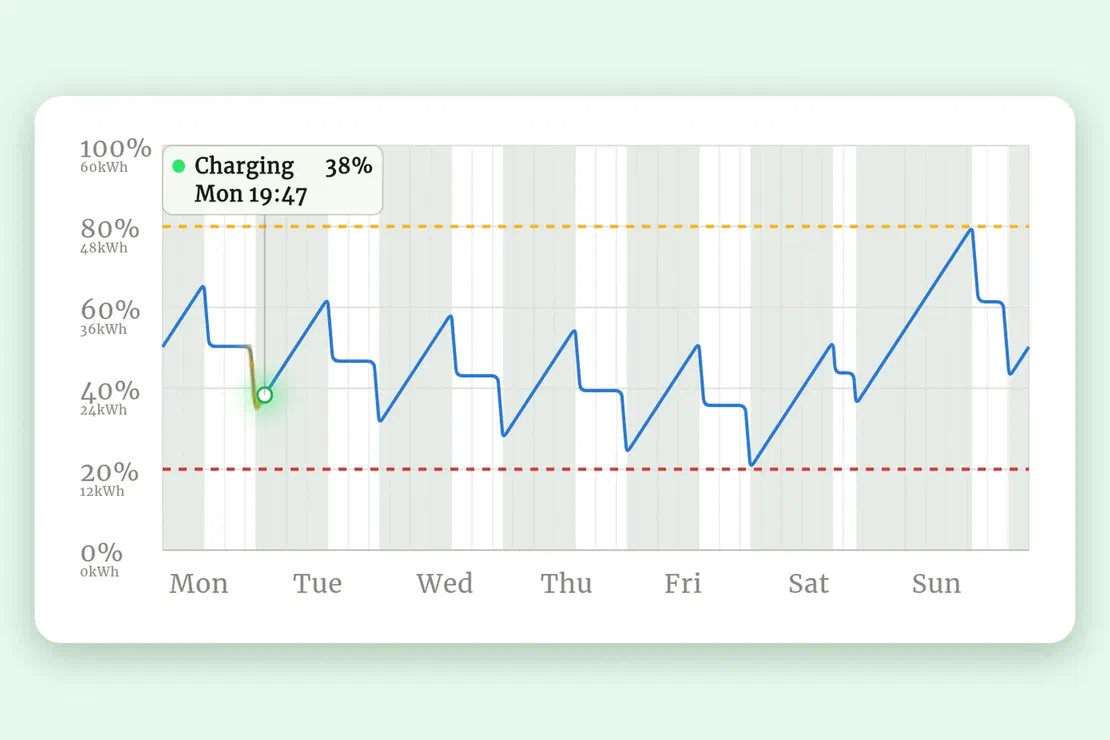
A car sits parked for most of the week. A long night at home is a lot of charging time, even through an ordinary wall outlet. The calculator makes this visible. A chart traces the battery through all seven days, with a spark that travels along the line: green when charging, orange when driving, grey when idle.
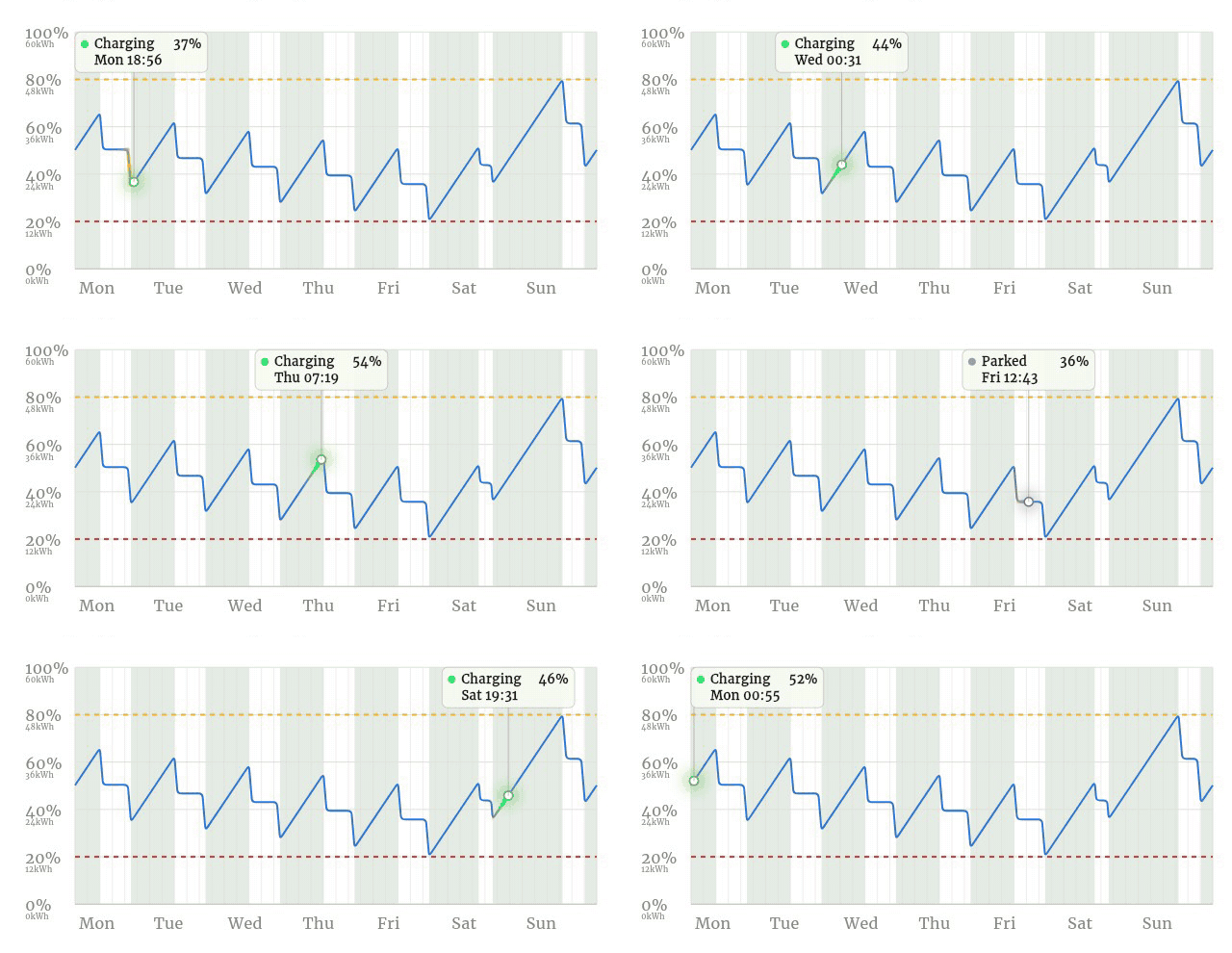
You can see, plainly, whether the line ever touches your floor. If it doesn’t, you don’t need a bigger charger. You need nothing more than the outlet you already have.
And for the weeks where it does matter, the calculator names the hardest day, tells you how low the battery dipped, and shows how much charger you need to fix it. When a week can’t be saved by any home charger, it says so honestly: the battery is the limit, not the charger, and the gap calls for a quick stop at a DC fast charger.
The math, not just the answer
We wanted you to be able to check our work. So under the answer is a chapter called “the math.” It shows each day’s lowest charge and writes the answer out as a single formula with your numbers in it.
There’s also a set of pro controls: slim sliders for every major setting. Drag one and the simulation responds immediately. And a button to reset everything to the default week when you’ve wandered too far.
One design choice we’re fond of: the answer stays hidden until you press the reveal button. The story comes first. You read the week, adjust it until it’s yours, and only then does the calculator show you what that week needs.
Your week stays with you
The calculator doesn’t send your numbers anywhere. Your changes are saved in your own browser and nowhere else. If you want to keep a result, you can email it to yourself, and the link in the email reopens the same week.
It’s a beta
We’ll be plain about this: it’s an early version, and the page says so. It’s a simplified model of a real week. It doesn’t know about cold weather, a heavy right foot, or the quirks of your particular car. Use it to learn what size of charger to ask about, not as a substitute for an electrician’s assessment of your panel.
If you share a charger in a condo, apartment or workplace, there’s a note at the end for you as well. Shared outlets are a bigger topic, and one we think about a lot at EVnSteven.
Try your own week
Open the calculator, change the story to match your life, and see what it says. If the answer surprises you, or if it’s wrong for your situation, I’d like to hear about it. It’s how the next version gets better.
David Williston Founder, EVnSteven